
In the first half of 2026, Chinese consumers generated more than 2.5 billion monthly search queries on Chinese AI platforms — a 340% increase compared to 2024. 67% of these users consult an AI before opening any e‑commerce app. For Western brands, this marks a paradigm shift that reshapes the entire journey from discovery to purchase decision.
What you’ll find in this article
Who uses AI in China to discover brands and how many they are
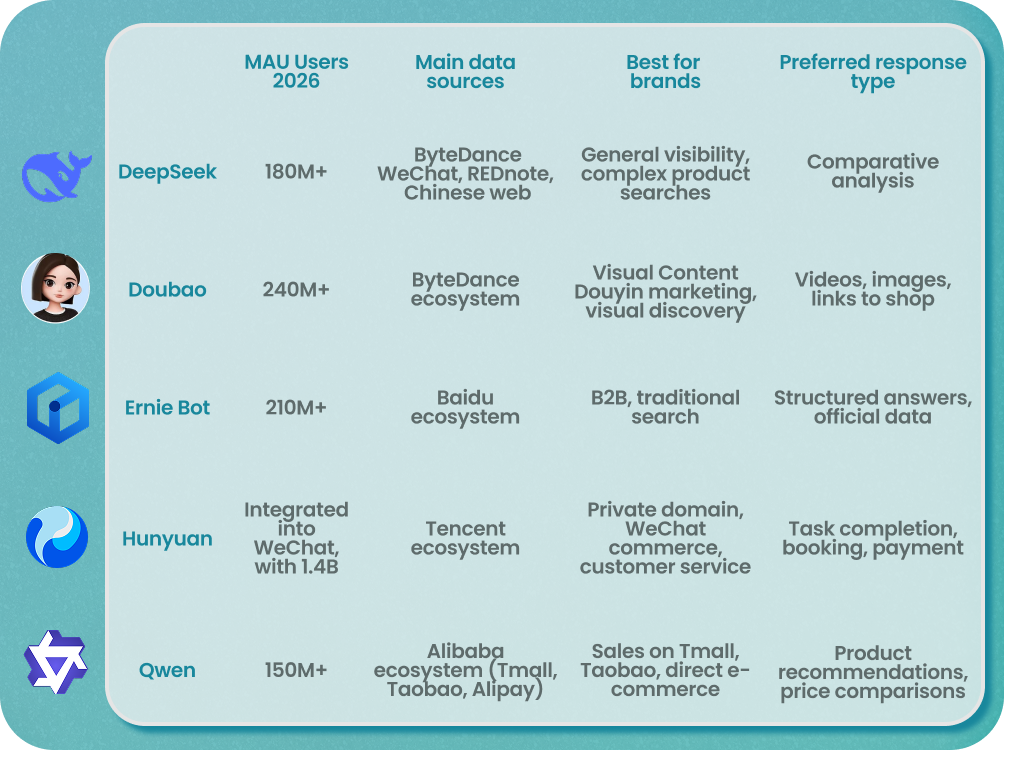
A comparison of the five major Chinese AIs for marketing
How AI is integrated into Chinese social platforms
A practical 5‑step strategy
For a deeper dive into Generative Engine Optimization in China and the role of AI, read also:
GEO Marketing in China: How to Build Your AI Presence
How AI Redefines Online Visibility in China
How many people in China use AI to discover brands?
The numbers for 2026 are unequivocal: Chinese consumers now generate over 2.5 billion AI search queries per month across DeepSeek, Doubao, and Ernie Bot — a 340% increase compared to 2024. DeepSeek alone surpassed 180 million monthly active users (MAU) in Q2 2026, while Doubao reached 240 million MAU in April.
For comparison, ChatGPT counted around 200 million active users globally in the first half of 2026 — meaning that individual Chinese platforms are now matching or surpassing the most dominant Western LLM.
But the numbers don’t tell the whole story. 67% of users consult AI before a major purchase on Tmall or JD.com, and 31% of B2B decision‑makers use Ernie Bot or Qwen to research suppliers before contacting sales teams. AI is no longer a niche tool — it has become the primary trust filter through which Chinese consumers discover, evaluate, and choose brands.
The three segments driving the transformation
Gen Z and Millennials (18–35) — 58% of active AI users. AI is their natural starting point for any purchase decision. They use DeepSeek to compare technical specs, Doubao to explore visual trends, and Xiaohongshu to validate AI recommendations through community reviews.
B2B professionals (25–45) — 31% of enterprise decision‑makers. Qwen and Kimi are their preferred tools for analyzing technical documents, contracts, and white papers.
Consumers in lower‑tier cities — accelerated adoption thanks to 5G expansion and smartphone accessibility. Representing 60% of China’s population, they rely heavily on AI recommendations due to limited access to first‑hand information on international brands.
Value China, digital agency specialized in the Chinese Market, has extensive expertise in developing digital solutions and providing strategic consulting for brands operating in China.
Looking to build your digital marketing strategy for China?
Contact us at: info@valuechina.net
The Five Chinese AIs Shaping Digital Marketing
DEEPSEEK
Launched in January 2025, DeepSeek quickly became a market phenomenon. With an open‑source architecture (MIT license) and drastically lower inference costs than Western models, it reached 89% market share in China and over 143 million MAU by August 2025. Its step‑by‑step reasoning approach makes it highly reliable for complex queries.
Why it matters for marketing: DeepSeek is the AI Chinese consumers use to compare brands, verify reviews, and receive purchase recommendations. Its reasoning‑driven approach makes it especially influential in high‑involvement decisions. Brands appearing in DeepSeek’s answers benefit from an implicit endorsement effect.
Data sources: DeepSeek draws from Chinese‑language content: WeChat Official Accounts, Douyin content, Xiaohongshu reviews, and government‑approved datasets. Western brands that publish only in English or lack structured presence on Chinese social platforms remain invisible. Chinese LLMs give 3–4× more weight to native platform content than to open‑web sources.
DOUBAO (ByteDance)
Doubao, ByteDance’s AI, surpassed 200 million daily active users (DAU) in 2026. During the 2026 Spring Festival Gala — China’s most‑watched TV event — Doubao recorded 1.9 billion interactions and processed 63.3 billion tokens in a single minute, proving it has become part of everyday life in China.
Why it matters for marketing: Integrated with the Douyin ecosystem, Doubao is a discovery engine. When users ask, “Show me summer outfits for men,” it returns Douyin videos from brands, complete with integrated shopping links. The path from query to conversion is measured in seconds, not days.
Ernie Bot (Baidu)
Ernie Bot surpassed 200 million MAU in January 2026 and has the strongest penetration in enterprise and government sectors. Baidu has deeply integrated Ernie across search, maps, e‑commerce, cloud, and public services.
Why it matters for marketing: Ernie Bot is the most reliable platform for brands in regulated industries such as healthcare, finance, and industrial B2B. It is also the AI most tightly integrated with traditional Chinese search: Ernie’s AI answers appear at the top of Baidu’s SERP, overriding organic results. Optimizing for Ernie means optimizing for Baidu visibility.
Hunyuan (Tencent)
Tencent is building a full AI agent inside WeChat, the super‑app with 1.4 billion users. Hunyuan 3.0 launched in April 2026, backed by RMB 18 billion in AI investments in 2025, with plans to double in 2026.
Why it matters for marketing: WeChat’s AI agent will book restaurants, purchase products, and manage payments — all through mini‑programs. This means the entire customer journey, from discovery to conversion, could happen inside WeChat, with AI acting as the intermediary. Tencent is already testing AI customer service agents that allow brands to manage FAQs and order status 24/7 in Chinese.
Qwen (Alibaba)
Qwen surpassed 150 million MAU in 2026 and is the only Chinese model with open weights, available on Hugging Face for custom fine‑tuning. Its real strength lies in its native integration with Alibaba’s ecosystem.
Why it matters for marketing: Qwen is natively connected to Tmall, Taobao, and Alipay. During the 2026 Spring Festival, Qwen users placed nearly 200 million orders for goods ranging from eggs to airline tickets and bubble tea — proving AI can function as a direct sales channel.
For brands selling on Tmall or Taobao, Qwen is a discovery channel directly linked to the point of sale. When users ask, “What’s the best Italian wine brand on Tmall?”, Qwen provides direct product links, aggregated reviews, and price comparisons. The distance between question and purchase is reduced to zero.
How Chinese AIs Draw from Social Platforms: Three Ecosystems, Three Logics
REDnote (Xiaohongshu)
By 2026, REDnote has become a true search engine: 70% of users search within the app before scrolling the feed. Its CES (Community Engagement Score) rewards content that sparks conversation — follows (8 points), comments and shares (4 points), likes and saves (1 point).
How AI uses Xiaohongshu: Chinese LLMs give special weight to REDnote reviews because they are seen as community‑validated facts. When models encounter conflicting information, they prioritize user sentiment from reviews. In 2026, Xiaohongshu actively combats AI‑generated spam, having removed 3.2 million fake notes and 600,000 low‑quality AI notes in the first half of 2025.
Within WeChat’s ecosystem, WeChat Channels (video accounts) differ from Douyin because recommendations are based on social relationships: if a friend likes a video, it is pushed into their friends’ feeds, creating a direct “social endorsement” effect.
How AI uses WeChat: Yuanbao (Tencent’s AI interface) and Hunyuan draw from an extensive database of Official Accounts and Channels. AI answers often include official articles, Channel videos, and mini‑program information. For brands, an active WeChat Official Account becomes a source of entity authority that AI uses to understand who you are and what you do.
Douyin
Douyin’s 2026 algorithm predicts user behavior: it estimates the likelihood of actions such as likes, comments, saves, and re‑watches, assigning different weights. Long‑term actions like saving or follow updates now carry more weight than simple video completion. Medium‑to‑long videos are growing, provided they offer high informational density.
How AI uses Douyin: Doubao and DeepSeek index Douyin content as a primary source. When users ask about a product, AI cites Douyin videos, descriptions, comments, and reviews. Brands producing high‑quality Douyin content — tutorials, informational videos, unboxing — are effectively building the training data AI uses to recommend their products.
How to Position Your Brand for Chinese AIs
1. Publish Where AI Looks — in Chinese
Chinese LLMs prioritize native content from WeChat, Douyin, and Xiaohongshu. Official Accounts, REDnote search‑optimized posts, and high‑quality Douyin videos are more valuable than traditional SEO pages. Content must be in Chinese, culturally localized, and structured for automatic extraction.
2. Build Consistent Entity Authority
AI must understand who you are and what you do. Ensure your brand is defined consistently across all platforms.
3. Invest in Verified Reviews as Training Data
A steady flow of fresh, verified reviews provides training data confirming your brand’s current relevance. A brand with 1,000 positive Tmall reviews has a citation advantage over one with zero reviews but a perfect website.
4. Create Extractable Content for AI
Each section of your content should be readable in isolation. Chinese AIs extract text fragments — if your key answer is buried in paragraph seven, the AI may not find it.
5. Monitor Your AI Visibility Across Platforms
Track brand mentions across platforms. Competitive benchmarking is essential to understand where you may be losing ground.